Managing Copilot in Microsoft Edge

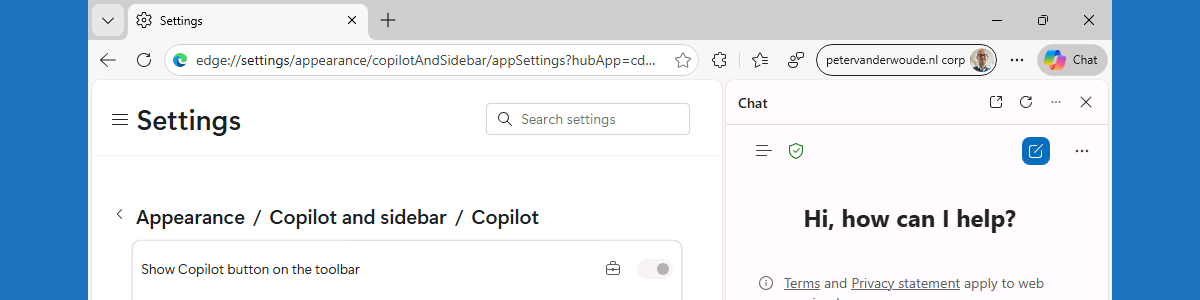
This week is all about managing Copilot within Microsoft Edge. There were already some nice configurations available for a while and recently an additional configuration was added around sharing tenant-approved browser history with Copilot search. That was a nice trigger for this post, focused on managing those available configurations. Working with Copilot in Microsoft Edge, does often require the organization to make that functionality available to the users. The good part is that it is often already disabled by default when using an organizational account. Especially in the EU, Copilot in Microsoft Edge has some default constraints that can be adjusted when needed. That is for example applicable to configuration around accessing Microsoft Edge page content for Entra accounts. This post will provide a closer …


Read more

Getting started with point-in-time restore in Windows

This week is all about another restore capability in Windows, and that capability is point-in-time restore. Recently, Microsoft has introduced many new features related to the backup, restore and recovery of Windows. That started with Quick Machine Recovery, which is focused on recovering Windows devices when encountering critical errors that prevent the device from booting, and that was quickly followed by Windows Backup for Organizations, which is focused on making it easier to switch towards new Windows devices. Now, the next addition is point-in-time restore, which is focused on restoring a Windows device to the exact state of that earlier point in time. Point-in-time restore relies on restore points that are stored locally on the device and that are captured by using Volume Shadow Copy …

Read more

Being careful with the ability to configure the preferred Entra tenant domain name

This week will be a relatively short blog post about a relatively often seen challenge with the configuration to set the preferred Entra tenant domain name. More specifically, this post will be about the PreferredAadTenantDomainName policy setting. That setting can be used by an IT administrator to basically preconfigure the tenant domain name for the user. Practically that would mean that when the organization uses the @petervanderwoude.nl tenant domain name, this policy setting would be configured with petervanderwoude.nl and would make sure that the user only has to specify their username without the tenant domain name to actually sign in to the device. That can provide a much easier experience. It does, however, come with some drawbacks that should be taken into consideration. The main …

Read more

Getting started with the PowerShell script installer for Win32 apps

This week is all about the recently introduced functionality to use PowerShell scripts for installing and uninstalling Win32 apps. That functionality enables IT administrators to use a PowerShell script as the installer type for Win32 apps. To make that a little bit more concrete; it enables the IT administrator to select a PowerShell script that should be used for installing a Win32 app. Before it was already possible to use a PowerShell script within the command line for the installation of a Win32 app, but that always had to be a script that existed within the Win32 app content. The major challenge with that approach was that every adjustment to that PowerShell script would require building a new Win32 app. That was far from ideal, …

Read more